
In the era of industrial generative large language models (LLMs) and multimodal AI agents, computing infrastructure choices dictate training convergence speeds, Time-to-First-Token (TTFT), cost per generated token, and cluster energy efficiency. Modern AI compute has shifted from single-GPU dominance to an orchestrated ecosystem of Heterogeneous Computing and Domain-Specific Architectures (DSA).
This cheat sheet strips out legacy models and marketing noise, anchoring directly on production silicon microarchitectures and data center topologies. It provides a compact overview of CPU, GPU, TPU, LPU, NPU, and DPU architectures, alongside major global AI accelerators (Huawei Ascend, Cambricon, Hygon, AWS Trainium, Meta MTIA, Microsoft Maia, NVIDIA Blackwell, etc.), including LLM VRAM sizing rules, cluster operational diagnostics, and MFU evaluation scripts.
🔗 Related Cheat Sheets: LLM & Agent Technical Concepts Cheat Sheet · Core AI Algorithms Cheat Sheet · Operations & High-Concurrency Systems Cheat Sheet
Modern AI Chip Microarchitecture & Data Center Pipeline Overview
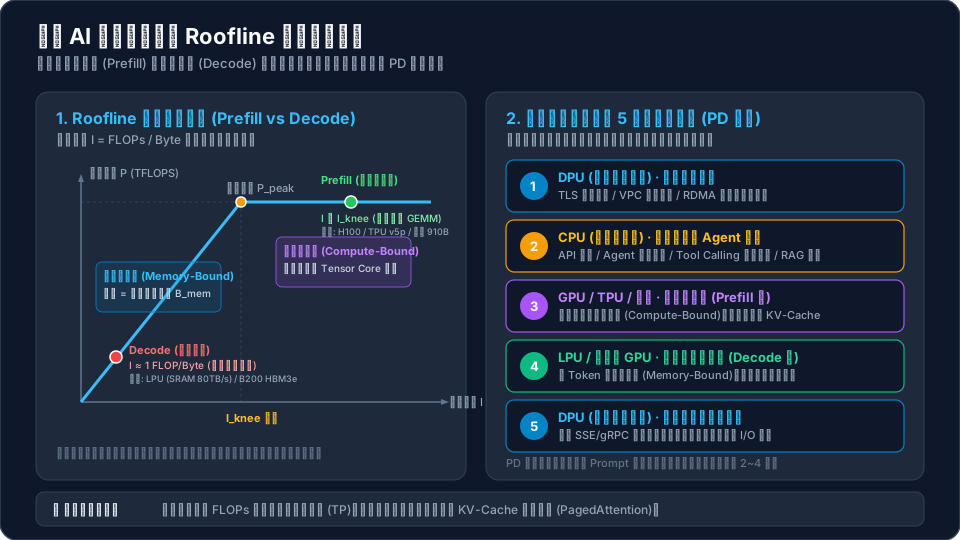
1. Modern AI Data Center End-to-End Pipeline (PD Disaggregation)
The complete lifecycle of an LLM request in a modern cloud AI data center follows the pipeline: Data Offload ➔ Orchestration ➔ Prefill Compute ➔ Decode Generation ➔ Response Dispatch:
| Step | Stage | Primary Silicon | Core Workload & Hardware Behavior | Primary Bottleneck | Representative Hardware |
|---|---|---|---|---|---|
| 01 | Network Ingestion & Packet Decryption | DPU (Data Processing Unit) | Terminates client TLS traffic at line-rate; handles VPC routing & firewall rules; writes directly to host memory via RDMA/RoCEv2 zero-copy | I/O & Packet Processing Line Rate (PPS / Gbps) | NVIDIA BlueField-3, AWS Nitro, AMD Pensando |
| 02 | Orchestration & Context Scheduling | CPU (Central Processing Unit) | Runs API gateways & agent execution loops; handles Tokenization, Vector DB RAG retrieval, Function Calling schema validation, and request batching | Single-Core Clock & Branch Latency (IPC / Branch) | AMD EPYC 9004/9005, Intel Xeon 5th/6th Gen, NVIDIA Grace, Ampere Altra |
| 03 | Prompt Prefill | GPU / TPU / Dedicated ASIC | Parallely processes all input Prompt Tokens in one pass, computes self-attention matrices, and outputs KV-Cache; dense GEMM matrix operations | Compute-Bound (TFLOPS) | NVIDIA H100/H200/B200, Google TPU v5p/v6e, Huawei Ascend 910B/910C |
| 04 | Autoregressive Decode | LPU / High-Bandwidth GPU | Incrementally generates tokens one-by-one based on KV-Cache; each step must read full model weights from memory | Memory-Bound (GB/s, Bandwidth) | Groq LPU (On-chip SRAM 80 TB/s), NVIDIA B200 (8 TB/s HBM3e) |
| 05 | Streaming Output & Cleanup | DPU (Data Processing Unit) | Streams generated tokens via SSE/gRPC back to client; frees compute queues, decoupling host CPU/GPU from network socket bottlenecks | Network Interrupts & Protocol Overhead | NVIDIA BlueField-3, AWS Nitro |
2. Six Core Computing Architectures Comparison Matrix
| Architecture | Core Microarchitecture & Compute Mechanism | Storage Medium & Typical Bandwidth | Physical Bound / Bottleneck | Typical TDP | Software Ecosystem / Compiler | Typical Production Silicon | Primary Production Role |
|---|---|---|---|---|---|---|---|
| CPU (Central Processing Unit) | Low core count, superscalar out-of-order execution, deep branch prediction, vector extensions (AVX-512, AMX) | DDR5 DRAM (~300 - 800 GB/s) |
Clock frequency, memory latency & DRAM bandwidth | 200W - 400W | C/C++, Rust, x86/ARM Assembly | Intel Xeon, AMD EPYC, NVIDIA Grace | Cluster orchestration, serial business logic, I/O scheduling, Tokenization |
| GPU (Graphics Processing Unit) | Thousands of SIMT ALUs, dedicated Tensor Cores, warp schedulers, mixed-precision matrix acceleration | HBM3e / HBM3 (3 - 8 TB/s) |
Compute bound during Prefill (TFLOPS); Memory bound during Decode | 400W - 1000W | NVIDIA CUDA, TensorRT, Triton, AMD ROCm | NVIDIA H100/H200/B200, AMD MI300X | Foundation model training, large-scale prefill, multimodal inference |
| TPU (Tensor Processing Unit) | 2D Systolic Array matrix multiply units (MXU), decoupled VPU vector units | HBM2e / HBM3 (1.6 - 4.8 TB/s) |
Inter-chip ICI mesh latency, operator compilation coverage | 300W - 600W | XLA Compiler, JAX, PyTorch-XLA, TensorFlow | Google TPU v4, v5e, v5p, v6e (Trillium) | High-throughput distributed training & inference within Google Cloud |
| LPU (Language Processing Unit) | Deterministic Tensor Streaming Core (TSC), instruction-less compiler scheduling, pure on-chip memory | Ultra-dense on-chip SRAM (Up to 80 TB/s) |
Extreme silicon cost, strictly bounded on-chip capacity (~230 MB/chip) | ~300W | Custom Groq Compiler | Groq LPU v1 / v2 | Ultra-low-latency real-time voice & streaming text autoregressive decode |
| NPU (Neural Processing Unit) | Fixed-function MAC arrays, lightweight streaming vector units, aggressive sparsity support | LPDDR5X / Unified Memory (50 - 200 GB/s) |
Mobile thermal constraints, memory capacity, non-standard operators | 5W - 50W | Apple CoreML, Qualcomm QNN, Android NNAPI | Apple Neural Engine (ANE), Qualcomm NPU | Mobile & edge on-device inference, local AI photography, PC co-processing |
| DPU (Data Processing Unit) | Multi-core ARM/MIPS SoC + high-speed packet parsing pipeline + hardware crypto accelerators | Dedicated On-board DDR5 / LPDDR5 (~100 GB/s) |
PCIe bus bandwidth, packet processing PPS ceiling | 50W - 150W | NVIDIA DOCA, Linux Kernel, DPDK, SPDK | NVIDIA BlueField-3, AWS Nitro, Intel Mount Evans | Data center infrastructure offload, TLS decryption, RoCEv2/RDMA transport |
3. Global AI Compute Accelerator Landscapes
A. Domestic Independent Compute Accelerators
| Vendor / Line | Model | Process / Package | Peak Compute (BF16 / FP16) | VRAM Capacity & Type | Memory Bandwidth | Interconnect Protocol | Software Framework | Production Assessment & Best Fit |
|---|---|---|---|---|---|---|---|---|
| Huawei Ascend | Ascend 910B | Advanced 3D Multi-Die | ~320 - 380 TFLOPS (FP16) | 64 GB / 32 GB HBM2e | 1.2 TB/s | HCCS (392 GB/s) | CANN + MindSpore / Ascend PyTorch | Most complete production ecosystem; widely adopted for LLM pre-training & cluster inference |
| Huawei Ascend | Ascend 910C | Multi-Chiplet 3D CoWoS | ~600+ TFLOPS (BF16) | 128 GB HBM3 | ~2.4 - 3.2 TB/s | HCCS v2 (~780 GB/s) | CANN 8.0+ | Direct competitor to NVIDIA H100 tier clusters; foundation model training |
| Cambricon | MLU370-X8 | 7nm Chiplet | ~256 TFLOPS (FP16) | 48 GB LPDDR5 | 614 GB/s | MLU-Link (200 GB/s) | Neuware | Cost-effective CV & NLP enterprise inference workloads |
| Cambricon | Siyuan 590 | 7nm CoWoS | ~512 TFLOPS (BF16) | 64 GB / 96 GB HBM2e | ~1.6 TB/s | MLU-Link 2.0 | Neuware + Cambricon PyTorch | Focused on enterprise fine-tuning & large-scale production inference |
| Hygon | DCU DeepComputing Z100 | Advanced FinFET | ~180 TFLOPS (FP16) | 32 GB HBM2 | ~1.0 TB/s | PCIe 4.0 / Proprietary Fabric | DTK (Highly ROCm/CUDA compatible) | High source-code compatibility with CUDA libraries; lowers migration friction |
| Moore Threads | MTT S4000 | 7nm MUSA Architecture | ~100 TFLOPS (FP16) | 48 GB GDDR6 | 768 GB/s | MT-Link (240 GB/s) | MUSA Software Stack | Graphic rendering + general AI hybrid acceleration nodes |
| Biren Technology | BR100 | 7nm Chiplet CoWoS | ~1000+ TFLOPS (INT8) | 64 GB HBM2e | 1.6 TB/s | BLink (640 GB/s) | BIRENSUPA | High architectural throughput; expanding operator coverage |
B. North American Cloud Hyperscaler Custom ASIC Matrix
| Cloud Hyperscaler | Chip Family | Primary Fabrication | Primary Workload Focus | Core Microarchitecture Highlight | Software Toolchain | Key Engineering Trade-off |
|---|---|---|---|---|---|---|
| TPU v5p / v6e | TSMC 4nm / 5nm | Large-scale pre-training (v5p), high-throughput inference (v6e) | 3D Torus optical network interconnect (ICI) scaling up to 8,960 chips | XLA, JAX, PyTorch | Eliminates InfiniBand switch costs; requires XLA graph compilation | |
| AWS | Trainium2 (Trn2) | TSMC 4nm | 100B+ parameter model training | 4x compute density over Trn1, integrated with AWS NeuronCore-v2 | AWS Neuron SDK | Tight AWS ecosystem binding; standard PCIe/EFA cluster topology |
| AWS | Inferentia2 (Inf2) | TSMC 7nm | Real-time generative model inference | Dedicated NeuronCores with on-chip interconnect and direct media decoders | AWS Neuron SDK | High throughput-per-dollar ratio for stable long-running deployments |
| Meta | MTIA v2 (Artemis) | TSMC 5nm | Recommendation ranking & GenAI inference | 8x8 matrix processor tiles paired with large on-chip SRAM pools | PyTorch native integration | Tailored for Meta's DLRM recommender workloads and Llama inference |
| Microsoft | Azure Maia 100 | TSMC 5nm | Azure OpenAI API & Bing Copilot inference | Custom sub-8-bit data types, custom high-density liquid cooling manifold | Custom Triton backend | Custom built for Azure data centers and OpenAI workload profiles |
4. LLM VRAM & Bandwidth Calculation Guide
1. Mathematical Formulas
A. Static Model Weights Footprint
$$\text{VRAM}_{\text{weights}} = \frac{P \times \text{Bits per Parameter}}{8 \times 1024^3} \text{ (GB)}$$
- FP16 / BF16 (16-bit): Each parameter requires 2 Bytes. Example: 70B model requires $70 \times 2 = 140 \text{ GB}$.
- INT8 (8-bit): Each parameter requires 1 Byte. Example: 70B model requires $70 \times 1 = 70 \text{ GB}$.
- FP4 / INT4 (4-bit): Each parameter requires 0.5 Bytes. Example: 70B model requires $70 \times 0.5 = 35 \text{ GB}$.
B. Dynamic KV-Cache VRAM Footprint (Per Concurrent Request, Per Token)
$$\text{Memory}{\text{KV-Cache}} = 2 \times L \times H{\text{kv}} \times D_{\text{head}} \times \text{Precision (Bytes)} \times S \text{ (Bytes)}$$
- $L$: Number of Transformer layers.
- $H_{\text{kv}}$: Number of Key-Value attention heads (Grouped Query Attention reduces this significantly compared to full MHA).
- $D_{\text{head}}$: Dimension per attention head (typically 128).
- $S$: Context sequence length (tokens).
2. Standard LLM VRAM Sizing Reference Table
| Model Class | Layers ($L$) | KV Heads ($H_{\text{kv}}$) | Weights (FP16) | Weights (INT8) | Weights (INT4) | KV-Cache / Req (4k tokens) | KV-Cache / Req (32k tokens) |
|---|---|---|---|---|---|---|---|
| 7B (Llama-3-8B) | 32 | 8 | ~16 GB | ~8.5 GB | ~4.5 GB | ~0.13 GB | ~1.05 GB |
| 14B (Qwen-2.5-14B) | 48 | 8 | ~29 GB | ~15 GB | ~8.2 GB | ~0.19 GB | ~1.57 GB |
| 70B (Llama-3-70B) | 80 | 8 | ~142 GB | ~75 GB | ~40 GB | ~0.32 GB | ~2.62 GB |
| 72B (Qwen-2.5-72B) | 80 | 8 | ~146 GB | ~78 GB | ~41 GB | ~0.32 GB | ~2.62 GB |
| 405B (Llama-3-405B) | 126 | 8 | ~820 GB | ~430 GB | ~220 GB | ~0.51 GB | ~4.12 GB |
💡 KV-Cache Sizing Rule: At concurrency $B = 64$ and context $32\text{k}$, a 70B model's KV-Cache alone consumes $64 \times 2.62\text{ GB} = 167.7\text{ GB}$! This exceeds the static weights footprint. Employing PagedAttention and FP8 KV-Cache quantization is essential.
5. AI Cluster Operations & Monitoring Command Matrix
1. NVIDIA GPU Diagnostic Commands
# 1. Output GPU status continuously in CSV format (Index, Name, Temp, Utilization, Memory, Power)
nvidia-smi --query-gpu=index,name,temperature.gpu,utilization.gpu,utilization.memory,memory.used,memory.total,power.draw --format=csv -l 1

# 2. Check NVLink hardware link status and health
nvidia-smi nvlink -s

# 3. Check NVLink CRC error packet counts (rising counts indicate loose physical cables or slots)
nvidia-smi nvlink -e

# 4. View inter-GPU physical topology (identifies NVLink / PCIe / NUMA boundaries)
nvidia-smi topo -m

# 5. Lock GPU core and memory clocks (benchmarking and jitter elimination)
sudo nvidia-smi --lock-gpu-clocks=2100,2100

# 6. Run DCGM Level 3 deep hardware diagnostics (includes memory stress test)
dcgmi diag -r 3
2. Huawei Ascend NPU (CANN) Diagnostic Commands
# 1. Query all Ascend NPU chips, HBM usage, and driver versions
npu-smi info

# 2. Continuously monitor NPU compute utilization, temperature, and power draw (1s interval)
npu-smi info -w 1

# 3. Check HCCS high-speed interconnect topology between Ascend chips
npu-smi info -t hccs -i 0

# 4. View motherboard temperature sensors and power health
npu-smi info -t board -i 0

# 5. Query device error codes and hardware alarm logs
npu-smi info -t error-code -i 0
3. AMD Instinct GPU (ROCm) Commands
# 1. Monitor MI300X VRAM, utilization, temperature, and power
rocm-smi --showuse --showmeminfo vram --showtemp --showpower

# 2. Display intra-node XGMI interconnect bus topology
rocm-smi --showtopo
4. Model FLOPs Utilization (MFU) Production Estimation Script
def calculate_mfu(
    num_params_billion: float,      # Model parameters in billions (e.g., 70.0)
    throughput_tokens_per_sec: float,# Overall cluster generated tokens per second
    num_gpus: int,                  # Total number of participating GPUs (e.g., 8)
    peak_tflops_per_gpu: float,     # Theoretical peak TFLOPS per GPU (e.g., H100 FP16 peak = 989.0)
    is_training: bool = False       # True for training (6*P), False for inference (2*P)
) -> float:
    """Calculates Model FLOPs Utilization (MFU). Typical top-tier clusters achieve 40% - 55%."""
    # Forward pass: 2*P FLOPs/token. Backward pass: 4*P FLOPs/token. Training total: 6*P.
    factor = 6.0 if is_training else 2.0
    flops_per_token = factor * (num_params_billion * 1e9)

    # Achieved compute throughput in TFLOPS
    achieved_tflops = (throughput_tokens_per_sec * flops_per_token) / 1e12

    # Cluster theoretical peak compute in TFLOPS
    total_peak_tflops = num_gpus * peak_tflops_per_gpu

    mfu = (achieved_tflops / total_peak_tflops) * 100.0
    return round(mfu, 2)

# Example: 8x H100 running 70B model inference at 800 tokens/s
mfu = calculate_mfu(num_params_billion=70, throughput_tokens_per_sec=800, num_gpus=8, peak_tflops_per_gpu=989)
print(f"Observed Cluster MFU: {mfu}%")
# An MFU < 15% indicates severe memory bandwidth starvation or inter-node network bottlenecks.
6. Architectural Evolution Summary
- Domain-Specific Architectures (DSA) End Monolithic GPU Monopoly: Compute is transitioning from homogeneous scaling to heterogeneous orchestration. CPUs handle dynamic control flow; DPUs offload networking and security; GPUs/TPUs process large-context prefill; LPUs specialize in low-latency autoregressive decode; and NPUs power ultra-efficient edge inference.
- PD Disaggregation Is the Production Paradigm: Compute-intensive Prefill and memory-intensive Decode phases demand diametrically opposed hardware characteristics. Separating them across RDMA-linked nodes prevents resource contention and multiplies cluster throughput per watt.
- Software-Hardware Co-Design Is the True Differentiator: Without a high-efficiency compiler (TensorRT, Triton, CANN, OpenXLA), specialized hardware yields little real-world benefit. Operator coverage, automated kernel fusion, and virtualized memory management remain the ultimate yardsticks of silicon maturity.