
White moves first, and players alternate one move at a time; the objective is to checkmate the opponent's King. A player may never make a move that exposes their own King to check. The King is never physically captured or removed from the board.
Piece Moves · Setup & Coordinates · Special Moves · Wins & Draws · Algebraic Notation
Moves of the Six Pieces
| Piece | Notation | Movement & Capture Mechanics | Movement Constraints |
|---|---|---|---|
| King ♔ / ♚ | K |
Exactly 1 square in any direction (orthogonal or diagonal) | Cannot move into check; kings cannot occupy adjacent squares |
| Queen ♕ / ♛ | Q |
Any number of unoccupied squares in any straight or diagonal line | Cannot jump over other pieces |
| Rook ♖ / ♜ | R |
Any number of unoccupied squares horizontally or vertically | Cannot jump over other pieces |
| Bishop ♗ / ♝ | B |
Any number of unoccupied squares along diagonals | Cannot jump over pieces; confined to squares of its initial color |
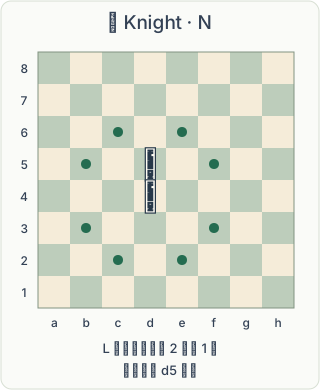
| Knight ♘ / ♞ | N |
Moves in an "L-shape": 2 squares in one direction, then 1 square perpendicular | Can jump over intermediate pieces; destination square cannot contain a friendly piece |
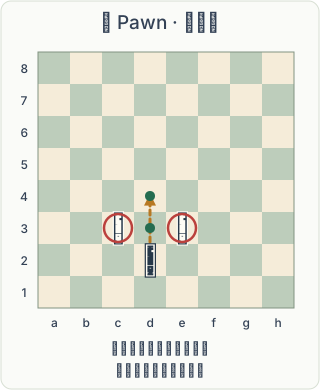
| Pawn ♙ / ♟ | (None) | Moves forward, captures diagonally; advances 1 square forward | Cannot move backward; optional 2-square advance strictly on its first move |
Universal Rules: A piece cannot land on a square occupied by a piece of the same color. A piece capturing an enemy piece replaces it on its square (with the exception of en passant). The sliding paths of Queens, Rooks, and Bishops are blocked by friendly pieces; they can capture the first enemy piece encountered but cannot pass through it. Pawns advance toward the opponent's back rank: White pawns advance toward rank 8; Black pawns advance toward rank 1.
Diagram Key: Green circles = legal destination squares; Red rings = legal capture squares; Orange dashed line = initial 2-square pawn advance option. (Kings and check restrictions are omitted in diagrams for clarity).
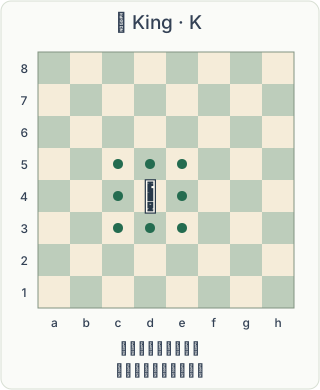
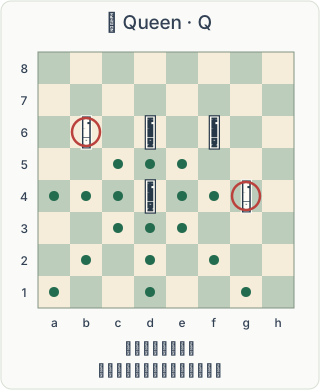
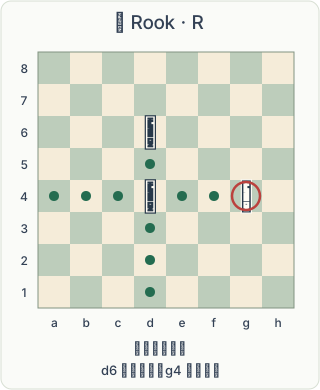
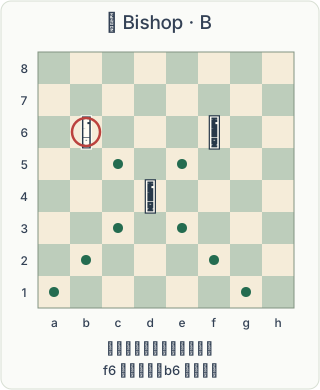
Standard Piece Valuations: Pawn $\approx 1$, Knight $\approx 3$, Bishop $\approx 3$, Rook $\approx 5$, Queen $\approx 9$. These are dynamic heuristic values for material exchanges. The King has infinite value and cannot be traded.
Board Setup & Coordinates
| Element | Quick Memory Rule |
|---|---|
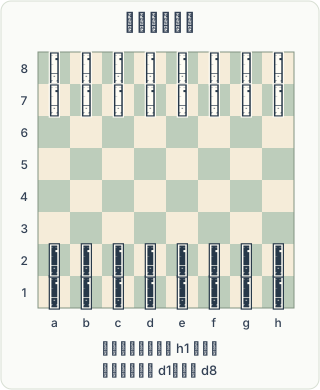
| Board Orientation | "White on right": The bottom-right corner square must be a light square (h1 for White, a8 for Black) |
| Files (Columns) | Letters a through h, reading from left to right from White's perspective |
| Ranks (Rows) | Numbers 1 through 8, reading from White's back rank (1) to Black's back rank (8) |
| Back Rank Order | From file a to h: Rook, Knight, Bishop, Queen, King, Bishop, Knight, Rook |
| Queen Placement | "Queen on her own color": White Queen on light d1, Black Queen on dark d8 |
| Pawn Ranks | White pawns on rank 2, Black pawns on rank 7; 16 pieces per player at start |
| Center Squares | The 4 critical center squares: d4, e4, d5, and e5 |
Special Moves
Castling
Castling is a dual-piece move involving the King and one Rook executed in a single turn: The King moves two squares toward the Rook, and the Rook leaps over the King to land on the square the King just crossed.
| Type | White Coordinate Path | Black Coordinate Path | Algebraic Notation |
|---|---|---|---|
| Kingside (Short) | King e1 → g1; Rook h1 → f1 |
King e8 → g8; Rook h8 → f8 |
O-O |
| Queenside (Long) | King e1 → c1; Rook a1 → d1 |
King e8 → c8; Rook a8 → d8 |
O-O-O |
Mandatory Preconditions:
- Neither the King nor the participating Rook have ever moved previously in the game.
- All squares between the King and the Rook are completely vacant (including
b1/b8for Queenside castling). - The King is not currently in check, does not pass through a square attacked by an enemy piece, and does not land in check.
Note: The Rook may pass through or land on an attacked square (b1/b8), and the Rook may be under attack prior to castling. When playing on a physical board, always touch and move the King first.
En Passant
When an opponent's pawn advances two squares from its starting rank and lands directly adjacent to a player's pawn on the same rank, the player may capture that pawn diagonally as if it had advanced only one square.
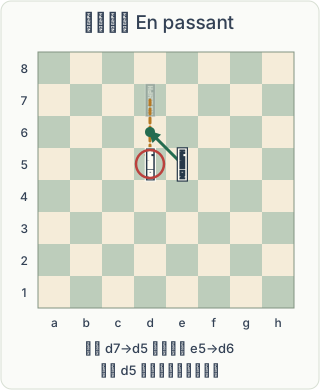
- Available only when a White pawn is on rank 5 or a Black pawn is on rank 4.
- Must be executed immediately on the very next move; the right to capture en passant is permanently lost for that pawn advance if not exercised immediately.
- Optional move; executing it must leave the player's own King safe from check.
Pawn Promotion
When a pawn reaches the eighth rank (rank 8 for White, rank 1 for Black), it must be immediately exchanged on that same turn for a Queen, Rook, Bishop, or Knight of the same color.
- A player may promote to a Queen regardless of whether their original Queen is still on the board (having multiple Queens is completely legal).
- A pawn cannot remain a pawn or promote to a King.
- Promoting to a piece other than a Queen (Rook, Bishop, or Knight) is termed Underpromotion (frequently used to deliver immediate checkmate or prevent unwanted stalemate).
Game-End Conditions: Wins & Draws
Check, Checkmate & Stalemate
| State | King Under Attack? | Legal Moves Available? | Outcome |
|---|---|---|---|
| Check | Yes | Yes | Must resolve check immediately |
| Checkmate | Yes | No legal moves available | Game over; player in checkmate loses |
| Stalemate | No | No legal moves anywhere on the board | Game over immediately; Draw (½–½) |
Three Ways to Escape Check:
- Capture the attacking piece.
- Block the line of attack by placing an intervening piece (impossible against Knights).
- Move the King to an unattacked square. (During a Double Check, the King must move).
Draw Conditions
| Draw Condition | Verification Rule | Claim Procedure |
|---|---|---|
| Stalemate | Player whose turn it is has no legal move and is not in check | Automatic instant draw |
| Dead Position | Neither player can checkmate the opponent by any sequence of legal moves | Automatic instant draw |
| Threefold Repetition | The exact same board position occurs 3 times (with identical active rights) | Claimed by the player whose turn it is |
| 50-Move Rule | 50 consecutive turns by each player with zero pawn moves and zero captures | Claimed by the player whose turn it is |
| Fivefold Repetition | The exact same position occurs 5 times | Automatic draw by arbiter |
| 75-Move Rule | 75 consecutive moves with zero pawn moves and zero captures | Automatic draw by arbiter (checkmate overrides) |
| Mutual Agreement | Both players agree to a draw during active play | Subject to tournament anti-quick-draw rules |
Dead Position Examples: King vs. King; King & Bishop vs. King; King & Knight vs. King; King & Bishop vs. King & Bishop where both Bishops are on squares of the same color.
Algebraic Notation Symbols
Standard FIDE English algebraic notation records each move with the piece letter followed by the target square (e.g. Nf3). Pawns do not use an initial letter (e.g. e4).
| Symbol | Description | Example |
|---|---|---|
K, Q, R, B, N |
King, Queen, Rook, Bishop, Knight | Bc4 = Bishop moves to c4 |
x |
Capture | Bxf7 = Bishop captures on f7; exd5 = e-pawn captures on d5 |
+ / # |
Check / Checkmate | Qh5+ (Check); Qxf7# (Checkmate) |
O-O / O-O-O |
Kingside / Queenside Castling | FIDE appendix also writes 0-0 / 0-0-0 |
=Q |
Pawn Promotion | e8=Q (Pawn promotes to Queen) |
e.p. |
En Passant capture | exd6 e.p. |
| File / Rank disambiguation | Disambiguates when two identical pieces can move to the same square | Nbd2 (Knight from b-file moves to d2); R1e2 |
1-0 / 0-1 / ½-½ |
White wins / Black wins / Draw | Recorded at the conclusion of the game |
!, ?, !!, ?? |
Good move, Mistake, Brilliant move, Blunder | Analytical commentary annotations (not move syntax) |
Golden Rules for the Opening
- Control the Center: Occupy and influence
d4,e4,d5, ande5with pawns and minor pieces. - Develop Minor Pieces Quickly: Bring Knights and Bishops into active squares; avoid moving the same piece multiple times in the opening.
- King Safety First: Castle early; do not bring out the Queen prematurely where it can be harassed with tempo by enemy minor pieces.
- Check Blunders Before Moving: Ask: "What is my opponent threatening? Does my move leave any friendly piece unprotected?"